simple is beautiful
Sydney Daily Photo: domestic architecture
2 ... 2 ...
Showing posts with label domestic architecture. Show all posts

Sunday, September 21, 2008

Tempe House - then and now (Tempe House Tour Part 8)

To finish this series about Tempe House I was keen to take some photos from similar vantage points from which 19th century artists depicted it. These were taken from Kendrick Park in Tempe, across the Cooks River.

Many people and heritage organisations argue that the Wolli Creek development has ruined the context and setting of Tempe House, and I agree. Others say that, sadly, it was the only way the house could be preserved at all. That is probably true too. In the 1990s the state government was lobbied to buy the site and restore the house, as the only one of its architect, Verge, still in its original setting, with no bulk behind. They declined.

I think it is such a shame that a development of this size and bulk was presented as the only option. Sadly, in Sydney, developers are allowed to extract every cent they can. Promises were also made that there would be public access, including the parkland sweeping down to the river, but it has never been open as far as I know, and the house, while beautifully restored by renowned heritage architectures is sitting unused and inaccessible (other than to curious bloggers who scramble up rock faces, scale walls and straddle fences...and to the owners of the apartments who have private access through electronic codes on gates.)

Postscript: This afternoon I went into the city to see an exhibition at the Museum of Sydney called Lost Gardens of Sydney. The garden of Tempe House is one of those featured.

Below: Taken 18 Sep 2008

Below: Cooks River Tempe House by Conrad Martens, 1838

Below: 18 September 2008

Below: Tempe House by Samuel Elyard, 1836
Below: Cooks River with Tempe House by James Clarke. I couldn't get a similar vantage point because the railway bridge now runs at the right, and the river is obscured by trees in the park

Friday, September 19, 2008

Wolli Dancing (Tempe House Tour Part 6)

Wolli Dancing relates to the Wolli tradition; a place that represents openness, which expresses joy, such as dancing. It captures the sensation and enthusiasm of the performers.

Artist Blaze Krstanoski-Blazeski. Unveiled 18 June 2008.

I'm also dancing to celebrate my loving mum's 80th birthday today!

Thursday, September 18, 2008

Wolli Creek development - the pool (Tempe House Tour Part 5)

The apartment pool is now obscured from view by opaque glass, but I took this pic in 2006 soon after completion.

Wednesday, September 17, 2008

Tempe House - the facade and Mount Olympus (Tempe House Tour Part 4)


Spark died in October 1856. There were no obituaries, and he is buried in an unmarked grave in St Peter’s Church cemetery, Tempe. he had already lost the house to trustees.

In December 1856 there was a partial subdivision of Tempe Estate into 123 suburban lots of between ½ and 2 acres. There was little interest and it was withdrawn in April 1859 and re-sub-divided.

The house and 11 surrounding acres were one lot, and the remainder were 1 to 20 acres.

Tempe was bought by two bachelor brothers, Patrick and Thomas Maguire of George St, Sydney. They paid £ 2000. Neither brother ever lived at Tempe, and it was occupied by a series of wealthy tenants. It was known as Greenbank at this time. The large block of flats immediately behind Tempe House is named Greenbank. The other is named Verge.

Probably the most notable tenant was Caroline Chisholm, dubbed “the immigrants’ friend”. She leased it to run “an educational establishment for young ladies”, until ill-health forced her to abandon it. Chisholm was once on the Australian $5 note, but lost that position when the $1 and $2 notes were replaced by coins. It is tradition to have the monarch's head on the lowest denomination note, so Queen Liz got the gig.

In 1885 the house passed into the hands of the Sisters of the Good Samaritan of St Benedict who operated it as St Magdalen’s Retreat for destitute women from 1884 to 1983.

Gradually the function changed from accommodation for destitute women to one primarily for women unable to find employment and in danger of prostitution. Former prostitutes, ex-prisoners and alcoholics were accommodated for two years to work in the laundry, dairy or poultry yard. Younger women were taught cooking, sewing and other domestic duties.

Originally the women accommodated were all volunteers, free to leave at any time, and then the courts increasingly referred young women judged to be in “moral danger”.

I believe that the house was sold to Qantas which had some plans to use it as a training base, but that never came to fruition. The house and grounds quietly disintegrated until it was eventually sold to developers, the results of which we see today.

Tuesday, September 16, 2008

Mount Olympus (Tempe House Tour Part 3)

The original owner of Tempe House, Alexander Spark Brodie had travelled extensively in Europe, having undertaken the classical gentleman’s Grand Tour of classical sites. As well as naming the estate “Tempe” after the Vale of Tempe in Greece, he named the rocky hill behind Mount Olympus.

Mount Olympus has had a piece sliced off it to accommodate the development.

Sunday, September 14, 2008

Tempe House (Tempe House Tour Part 2)

Yesterday we were at the back of Tempe House, looking between the church and house. Today we look back in the other direction.

The house was built for a wealthy and successful Scottish émigré, Alexander Brodie Spark. After achieving business success in London, Spark applied to emigrate to Australia, and arrived in Tasmania on 21 January 1823. Finding that not to his liking, he moved on to Sydney where he arrived on 17 February 1823. He opened a general store in George St, and eventually moved into wool exportation, and owned a ship. He was a major shareholder in the Bank of Australia.

On 10 August 1826, Spark purchased 110 acres of land on the south bank of the Cook’s River. The only way to cross the river was by boat. Spark had a private boatman, “Old Willy”.

Brodie was a great entertainer, and it soon became apparent that the cottage on the site was inadequate, so in 1834 he commissioned John Verge to design an arcadian villa with resemblance to a Greek temple. Verge was a major colonial architect, responsible also for Elizabeth Bay House and Camden Park at Menangle. Verge also designed Spark’s previous home, Tusculum, at Potts Point.

Tempe was completed in 1836, and Brodie made it his permanent home, leasing Tusculum, to the Anglican Bishop of Sydney.

Behind Tempe House (where we were yesterday)there was an orchard, greenhouse, shrubbery and gardener’s cottage. On the river he constructed a rococo bathing house. I'll feature the river in a later post, though, sadly, the bathing house is no more!

Wolli Creek - a new suburb (Tempe House Tour Part 1)

Come with me over the next few days as we have a look around a "brownfields" housing development: the re-use of inner-urban land for modern housing development.

The Wolli (pronounced Woll-eye) Creek apartment development is in an area previously called North Arncliffe. It will house 7000 people, and is an example of creating a new suburb in an inner urban area. It was the site of light industry and a magnificent historic house, Tempe House which had fallen in to disrepair. Come with me over the next week or so while we take a stroll through the Tempe House area of Wolli Creek.

From 1884 to 1983, the house was occupied by Catholic nuns, the Magdalen Sisters, and the church dates from that time. It is now de-commissioned as a church. It is meant to function as some kind of community facility, but as yet, nothing seems to have happened there - it is always locked and off-limits.

Below: The church and Tempe House. Over the next week I will tell you more about Tempe House.


View Larger Map

Tuesday, May 6, 2008

Five ways you can tell you are in Melbourne, not Sydney

Part Three: Fences, weatherboards and bricks


I've rarely seen these woven wire fences in Sydney, and weatherboard is not a particularly common building material. For cheap building material fibro is more prevalent in Sydney (and rarely seen in Melbourne). There are of course some weatherboard houses in Sydney, but it is rare to see them lovingly restored; these days they are more likely to be knocked down and replaced by a McMansion. Many inner suburbs of Melbourne have beautifully restored examples of Victorian and Edwardian weatherboard houses.

Now to the peak-capped brick fences. Common in 1950s Melbourne fences; unknown in Sydney.
The colour of bricks depends on the clay you have for raw material. This particular shade of red brick is a Melbourne special, as is the blonde brick. Having lived in both Melbourne and Sydney, show me a traditional commons brick from either city and I reckon I'd have a pretty good chance of getting its origin right. Weird, but there you are!


Wednesday, April 2, 2008

Spider threatens city!


A spider in the bush looks like it's hanging over this apartment block!

Thursday, March 27, 2008

In the shadow of Sydney Tower

Cnr Hargrave Lane & Yurong St, East Sydney (Darlinghurst)

Monday, March 17, 2008

Chiaroscuro


Light and shadow....late afternoon.

Tuesday, February 26, 2008

Victorian cottages, Arncliffe


Wollongong Rd, Arncliffe. You can see some more grandiose examples of local Victorian architecture if you click here.

Saturday, February 2, 2008

Hot Summer Night


As I write this, my son is playing video games with his friends in their open-doored garage across the road. A great place to be on a hot summer night!

Thursday, January 24, 2008

Emma Chisett

Any non-Australians want to have a go at guessing what "Emma Chisett" means in Strine (Australian "language") ?

Monday, January 14, 2008

Heritage, Cremorne

Love the evening sun on this building....it brings out the honey tones of the Sydney sandstone. What on earth possessed the council to approve the red brick carbuncle two doors down (see below)? It looks like a "heritage item" of the 1960s. These places have views over the harbour towards the Opera House and Bridge. I'll show that tomorow. They face the public reserve where you find the MacCallum Pool featured yesterday.


Tuesday, November 27, 2007

Terraces, Erskineville


A row of pretty, single storey terrace houses in Erskineville, a traditional working class area of Sydney, now gentrifying.

Friday, November 16, 2007

Sculpture By The Sea - "lemon tree"

Lots of school children were visiting the sculptures when I was there. Itwas great to se lots of young people engaging with the art. The orgaisers even published a children's activity book based around the exhibits.

Artist Irene Hoppenberg of Germany said about her work: " Yellow represents light. For me the lemons are a symbol of the southern countries and the sun."

For me, this work combines two icons of the Aussie suburban backyard - the Hills Hoist rotary clothes line and the lemon tree.

By the way, I am in love with the house high on the hill overlooking Tamarama Beach. It strikes me as somethign Jilly in Menton might post!


Thursday, November 1, 2007

Blue Boxes II

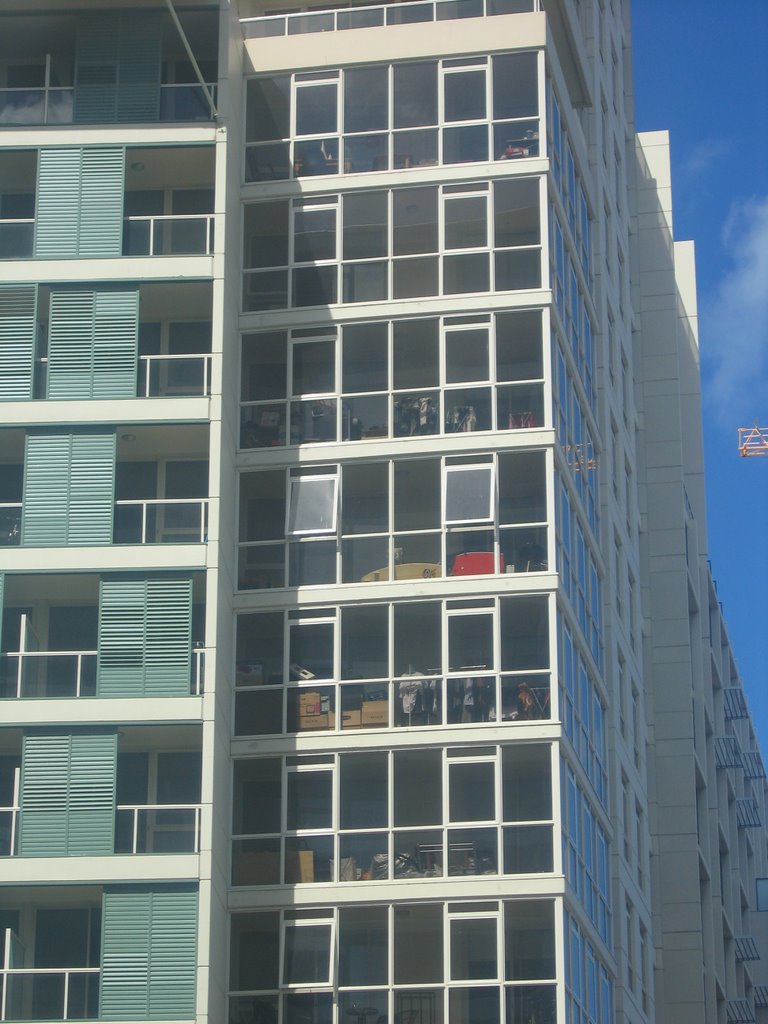
More boxes stacked on top of each other. Not containing apples, these harbour the species Homo sapiens which allegedly means "wise man" or "knowing man". Sometimes I really wonder about that :-)


Monday, September 17, 2007

LABEL